
Why check the return promise?
Shoppers ask whether they can return an item, how long they have, and whether returning it costs money. In Baymard Institute's survey chart of cart-abandonment reasons, 13% of US online shoppers who had abandoned a cart, after the “just browsing” segment was removed, selected an unsatisfactory returns policy. Respondents could select more than one reason. This is self-reported dissatisfaction, not measured sales lost because of inconsistent website copy. Baymard's chart and context; Baymard on return information.
There is no credible universal dollar figure for a conflicting return promise. A store-specific estimate would require its own affected-product views, orders, margins, return costs and a credible comparison after a correction.
Six public US policies / 26 September 2026
Return policy comparison: the conditions behind the headline
These six retailers were deliberately selected to illustrate different policy structures. The table summarizes general rules for ordinary eligible items from each retailer's own US policy page. It is not a random sample or a measure of how many US stores have a problem.
| Retailer | General rule | Condition that changes it |
|---|---|---|
| Gap | Generally 30 days from delivery for online orders. | Some member tiers get later merchandise credit; final-sale items are excluded. Returns are free. |
| American Eagle | Full refund within 30 days of purchase or merchandise credit within 60; online purchases get seven more days. | Final-sale items are excluded. Mail returns cost $5, with member and product exceptions; in-store returns are free. |
| lululemon | Eligible purchases generally have 30 days. | “We Made Too Much” sale items are final sale for nonmembers. Members can exchange them or return them for a gift card, in store only. Final-sale details. |
| Macy's | Most items within 30 days of delivery or purchase. | Online mail returns are free for Star Rewards members. Nonmembers pay $9.99 plus tax; in-store returns are free. Category and seller exceptions apply. |
| Kohl's | Most items within 90 days, or 120 with a Kohl's Card. | For shipped orders, the clock starts on the ship date. Customers pay mail postage; in-store returns are free. Premium electronics and watches have a 30-day window. |
| Nordstrom | Returns are handled case by case; its policy says there are no time limits for returns or exchanges. | Free mail and in-store returns are offered, with product and final-sale exceptions. |
A different rule is not automatically a defect. Item, shopper, purchase date, membership and return method determine which statement applies.
Verified public-page observation
A stale holiday date on American Eagle's policy
On 26 September 2026, the live American Eagle US return-policy page said merchandise bought “on or after Oct. 23” could be returned “through Feb. 1, 2026, or 30 days from the date of purchase, whichever is later.” The October year is unstated and February 2026 had already passed. The 30-day alternative matters: the stale holiday wording does not prove current returns are denied, that a product page contradicts the policy, or that sales were lost.
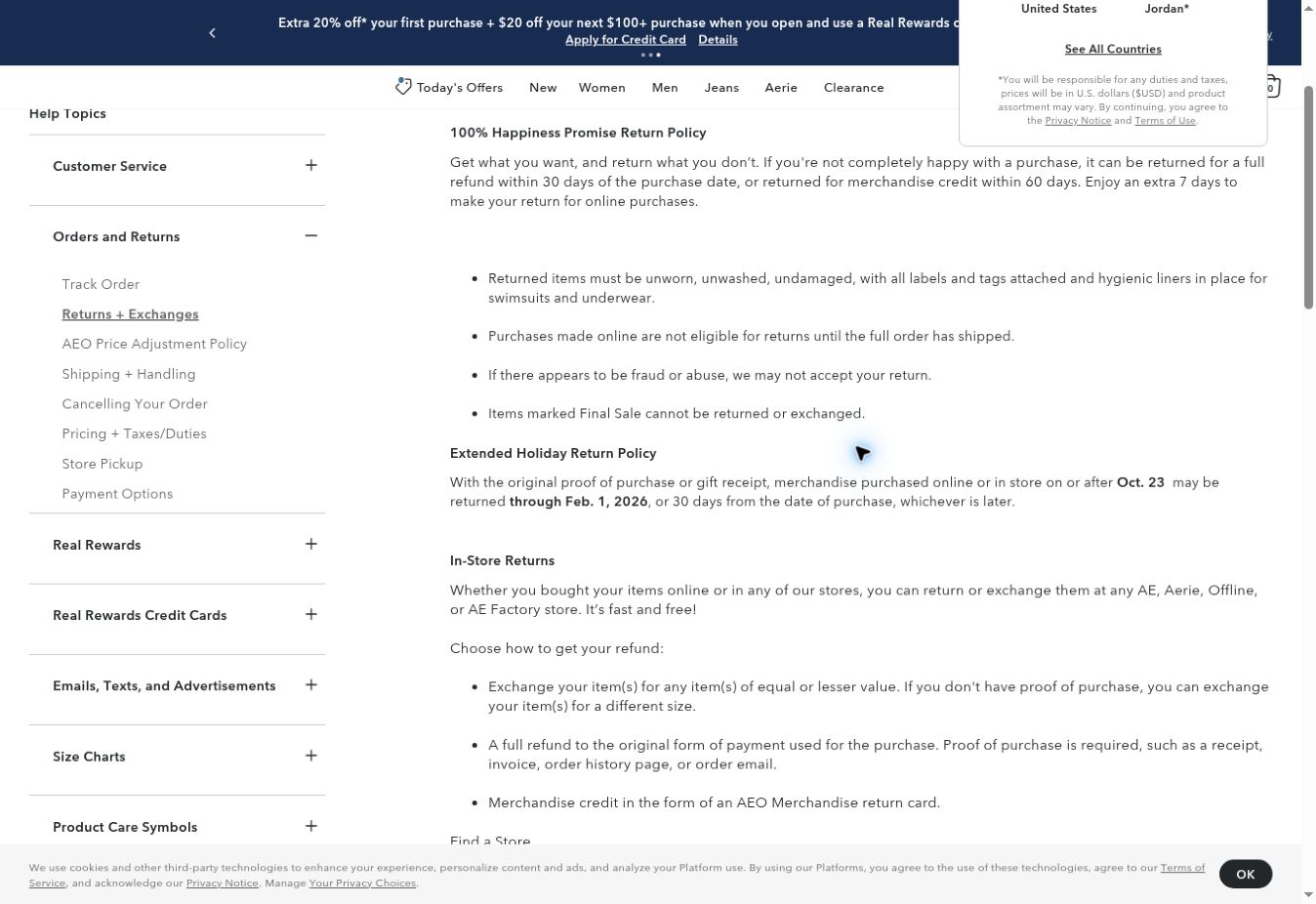
The specific fix is to clarify the applicable holiday period or remove the expired wording. The screenshot preserves what we observed if the source changes.
Findmetry diagnostic framework
How to audit a return policy page and product promises
Identify the exact item
Record the variant, seller, sale status and any “final sale” label.
Identify the shopper
Record country, membership tier and payment method when they affect the rule.
Identify the clock
Does it start at purchase, shipment, delivery or pickup? Record the date and the applicable deadline.
Identify the method and money
Compare mail with in-store returns, label or postage charges, and original-payment refunds with credit or gift cards.
Compare the same case across surfaces
Capture the product page, cart, policy, FAQ and relevant structured data at the same time. Two applicable statements that cannot both be true are a verified conflict. An explained exception is a conditional policy. An inaccessible or unresolved state is unverified.
What should a technical SEO team check?
Google's MerchantReturnPolicy documentation allows a business-wide policy under Organization and product-level exceptions under Offer. It can use return details alongside products in Search. Compare the visible policy with the site's structured data and the return settings in Merchant Center or Search Console. Google says Search Console policy settings can take precedence over on-page markup.
A complex policy may be better represented by a policy link than an oversimplified number. Do not publish a generic “free 30-day returns” value that misstates a product exception or a fee. We did not audit the six retailers' markup or measure any AI-search citation effect. Valid markup does not guarantee a particular search appearance.
Common return-policy audit questions
How long is a typical return window?
There is no single window across these six pages. Several state 30 days for most eligible items; Kohl's generally states 90 or 120 days depending on payment, and Nordstrom says there are no time limits but handles returns case by case, subject to exceptions. This selected comparison cannot establish an industry-wide average.
Do different return windows mean the site contradicts itself?
No. A member benefit, product exclusion or return method may explain the difference. Compare the same purchase context before making a claim.
Can we calculate lost sales from an unclear policy?
Not from a public page or Baymard's 13% survey response. A merchant needs its own funnel and order data and a credible test of a correction.
Scope and sources
Checked and updated 26 September 2026. This is a deliberately selected comparison of six public US policy pages, not a representative study or transaction test. We did not inspect every product, cart, account state or store's search markup, and we measured no customer behavior, revenue or AI visibility. The primary retailer pages are linked in the comparison; the external research is Baymard's survey chart and the technical reference is Google's merchant return-policy documentation.
Need to check your own pages?
Findmetry can investigate a specific public-site claim and show the observed URLs, scope and next action.
Request a diagnostic →